Mysterious Causes Of Death In Animals Shot Without Any Vital Organ Penetration. Part 3. A Blue Wildebeest Dies For No Obvious Reason.
by Andrew McLaren
(Soutpan, Free State. South Africa)
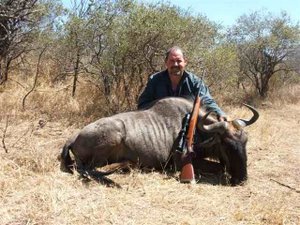
John Murdoch's Blue Wildebeest
The more you hunt, the more stories you have to tell!
In Part 1 I told the true story about a one shot kill of a springbuck ewe, while Part 2 tells an equally true story of an impala that also seemed to die for no obvious reason.
Now the story of my client and his blue wildebeest bull.
I was guiding a very pleasant Australian client on a blue wildebeest cull hunt. Long story preceding the shot, but let’s go directly to just before the shot was fired. The fully mature but not very old bull was facing us almost head-on at about 50 yards. This was near the end of the client’s hunt, and he had proven to be a good shot by making quite a few one-shot kills earlier in the hunt. At that range I was confident that his .308 win, that was fed with handloaded with 165 grain Woodleigh bullets, would be fatal. I watched the fall of the shot through my binoculars. The “thump” of the hit was very evident, and I saw the bull lurch on impact, turn around and run away with the rest of the herd. The client assured me that the ‘shot went off well’, so we took up the spoor. Within a few yards the first blood. Bright red blood. Follow and find very few small drops of bright red blood, not promising pienkish lung blood, on the spoor. But soon the blood was just a drop here and a small drop way further on. Do you know how difficult it is to track an individual blue wildebeest that ran off with a herd if there is no blood to show that you are on the right spoor? I’m a Professional Hunter, and can track some, but I’m by no means a professional not a tracker! Eventually, without calling in a professional tracker or dog, we find the bull collapsed into a thorn bush, stone dead! Drag the carcass out for photos, but where he lay there was almost no blood on the ground. Bullet entry was just off-centre and low down on the brisket.
Now those with a lot of hunting experience may know that such frontal shots are risky, in that it is all too often that the bullet does not penetrate into the lung cavity, but gets deflected along the rib bones. Stories have been told of such bullets traveling all along the ribs and then under the skin to far back on the animal. This bullet was found at the back of the shoulder – just about where one wants a broadside shot to enter – between the shoulder and the ribs. These was some blood along the bullet path, but surely not nearly enough to make a healthy blue wildebeest bull succumb from loss of blood. I don’t think a half a cup of blood, maybe much less, was found on the spoor. The main artery to the leg was not damaged at all. What little blood was lost came from just a ‘flesh wound’, that should not have been fatal at all! What killed it? Absolutely no fraction of the bullet had penetrated the heart or lungs, which were very closely examined. How come it died?
John Murdoch with his blue wildebeest that should not have died?
John, a man with sound medical and first aid knowledge suggested a possible cause of death. He said that in humans involved in motor car accidents the shock of the impact when wearing a seatbelt sometimes makes the heart stop. Paramedics have then had success in getting the heart to re-start beating by administering a very hard blow a with close fisted hit right to the sternum where the heart is situated. This practice is not normally recommended, or IIRC allowed to be followed by paramedics. If it were me lying there at an accident scene with my heart not beating at all, any paramedic attending to my soon to be ‘corpse’ is most welcome to hit me as hard as he wishes or do whatever else to attempt to start my heart beating again!
The blue wildebeest sure got a very hard hit on the sternum: A 165 grain .308 Woodleigh at about 50 meters packs a lot of punch released on expansion, as did this particular bullet! Let us for the sake of the argument accept that the shock of the bullet hitting the sternum caused the heart to stop. What would one expect to find? Here the bullet did penetrate and expand well, causing some muscle damage. Such a wound will bleed some through the entry hole, but there was no exit hole at all. We did find some initial big blood drops from close to where the blue wildebeest started running after taking the shot. If the heart was not pumping any more the loss of blood pressure would result in less bleeding further on, just as I found while tracking it on the blood spoor. Then eventually the brain would run out of oxygen and the animal would collapse into unconsciousness. The distance the bull ran was about what one can expect, say 400 or so yards? If, after collapsing into an unconscious state, with the heart still not pumping any blood, the animal will soon die from a lack of oxygen in the brain. When we found him, he was quite dead. The theory that the hard shock on the sternum caused the heart to stop beating adequately explains the death of this blue wildebeest in which absolutely no vital organ was penetrated by the bullet.
But what caused the death of a springbuck ewe? She also got a bullet hit right on the sternum. So the same theory can well explain her death. She remained walking in little circles roughly for the same time as the blue wildebeest took to run from where he took the shot to where we found him.
But the big healthy impala ram just toughed by a bullet on his side? The only organ near the bullet ‘touch’ – I cannot get myself to call it an ‘impact’ – was the paunch. Old hand hunters know that a shot in the stomach is a nasty and not nearly immediately fatal thing. In this case methinks that the shock of the bullet hitting the skin must have been transmitted somehow. How? That remains a complete mystery to me.
Comments for Mysterious Causes Of Death In Animals Shot Without Any Vital Organ Penetration. Part 3. A Blue Wildebeest Dies For No Obvious Reason.
|
||
|
||
|
||



Shakari Connection Bookshelf
Browse the Bookshelf mini-site for thousands of African hunting books and much more....

African Hunting Countries
- Hunting Benin Benin Travel
- Hunting Botswana Botswana Travel
- Hunting Burkina Faso Burkina Faso Travel
- Hunting Cameroon Cameroon Travel
- Hunting Central African Republic Central African Republic Travel
- Hunting Ethiopia Ethiopia Travel
- Hunting Mozambique Mozambique Travel
- Hunting Namibia Namibia Travel
- Hunting South Africa South Africa Travel
- Hunting Tanzania Tanzania Travel
- Hunting Uganda Uganda Travel
- Hunting Zambia Zambia Travel
- Hunting Zimbabwe Zimbabwe Travel
Hunting Gear For Africa
- Ammo Holders
- Flashlights / Torches
- Headlamps
- Other Light Gadgets
- Hearing Protectors
- Gaiters
- Personal Water Bottles
- Hydration Backpacks
European Hunting
African Travel For Hunters
- First Time To Africa?
- Money In Africa
- Travel Agents For Africa
- Airlines To Africa
- African Airports
- Airport Security Tips
- Tips For Packing Luggage
- Airline Baggage Allowances
- Airline Lost Baggage
- Jet-Lag Remedies & Longhaul Flight Survival
- Air Charters In Africa
- Visas & Passports
- Global Rescue
- Travel Insurance

African Hunter Magazine
African Game Animals
Miscellaneous Hunting Topics
- African Hunting Articles
- African Hunt Packing List
- Hunt Preparation Checklist
- African Trophy Photography
- African Hunting Seasons
- Weather In Africa
- African Moonlight
- Your African Hunt Stories
African Wildlife Art
Create Your Own Website

Affiliate Disclosure
Shakari Connection is a participant in the Amazon Services LLC Associates Program, an affiliate advertising program designed to provide a means for sites to earn advertising fees by advertising and linking to amazon.com
Visitors' Favourite Pages
|
|
|
|
|
| Double Rifles | Baboon Hunting | Safari Hats | Insect Repellents For Africa | African Hunter Shot Placement |


Copyright © 2008-2024. All rights reserved. No part of this website may be reproduced for publication without written permission.