Safari Hats
Page Updated: Sept 2023
Good safari hats are an essential part of your African hunting equipment - not only to protect yourself from the sun but also to reduce the chance of an animal spotting you.
'No one knows how ungentlemanly he can look, until he has seen himself in a shocking bad hat.' Robert Smith Surtees
A Spot Of Safari Hat History
Pith Helmets
Emulating the old Victorian hunters and Theodore Roosevelt, you really ought to wear a pith helmet for a truly authentic African safari hat.
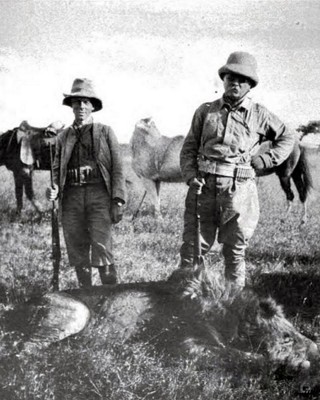
This hat (also known as a sun helmet, topee, sola topee, salacot or topi) was made of cork or the pith from the Sola plant of Asia and covered with cloth. It was designed to shade the head from the sun and was very popular with Europeans and Americans in tropical climates.
From 1870, the pith helmet was used by various military forces in the tropical colonies.
The helmet was made of pith with peaks front and rear, with holes for ventilation, a cloth covering and chin strap.
The pith helmet design is still prevalent as part military dress uniforms, though often decorated with spikes and plumes.
During the Anglo-Zulu war the British dyed their white cloth covering with tea, in an effort to camouflage. After this khaki coloured helmets became standard issue.
In the 1930s civilian life, the same pith helmet was worn (minus badges and regalia) to avoid sunstroke in the tropics by people of European origin, even indoors just in case the dangerous sun rays could penetrate the roof.
The potential dangers of the sun on the body was taken extremely seriously by the colonials in Africa and India. It was recommended they wear fabric 'neck curtains' hanging from the helmet to mid-back or even 3" thick spinal pads made of cork shavings.
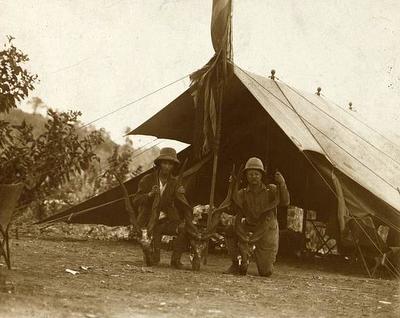
Slouch Hats & Terai Hats
Along with the pith helmet, slouch hats were also worn on safari in Africa, so-called because the brim on one side was down and on the other side was pinned up to the crown.
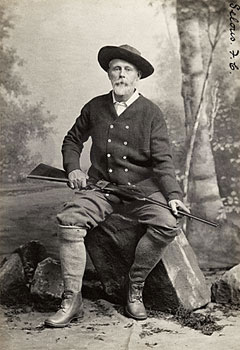 Frederick Selous in a slouch hat
This style was used by the British military in the Boer Wars when there was a shortage of cork helmets.
Other armies also used the slouch hat as uniform in the tropics and today the Australian military still wear them in parade uniform.
The terai hat is a version of the slouch hat which was worn by the Gurkhas and named after a region in Nepal.
As with the slouch hat, the terai was made of felt with pugree wound round the crown. Pugree is the Indian word for turban and refers to the pleated hat band.
Often the non-military terai hat brims were not pinned up on one side but just elevated on one side at a rakish angle.
The double terai hat is a slouch hat with a double thickness crown and brim designed for extra sun protection.
The principles of the 'terai' sun protection were used to design acceptably feminine hats for ladies and alternative styles for men similar to bowler hats or clerical hats.
Fast Forward To The Safari Hats Of The 1940s & 1950s
These were heydays of African hunting safaris when everyone who was anyone, disappeared into the African bush for months on end.
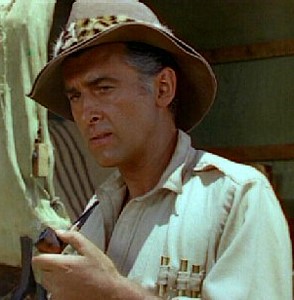 Stewart Granger in a double terai slouch hat - 1950
The felt slouch hat was still de riguer on African hunting safaris but the famous professional hunters of East Africa of this era injected a little Italian flair into their headwear.
Borsalino safari hats were practically mandatory headwear for all the professional hunters and consequently their hunting clients who were outfitted at Ahmed Brothers in Nairobi.
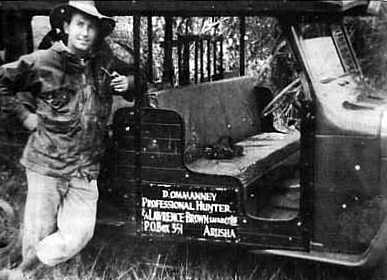
Borsalino was the leading manufacturer of the felt fedora hat from 1857 until the present. Originally furnished with a pugree hatband, the Borsalino safari hat has even been credited with saving the life of professional hunter Stan Lawrence Brown during an elephant attack. Read more in 'White Hunters: The Golden Age Of African Safaris' by Brian Herne
Tilley Hats Of The 1980s
This eminently practical hat - sun-proof, wind-proof, water-proof, insect-proof and with 'secret' pockets, found it's way from the sailing club into the African bush, primarily on the heads of photographic safari-goers.
A change of colour from white to khaki or olive green and the original Tilley hat still does little for it's wearer in the way of style. Retaining all the original practical features, Tilley hats now come in a myriad of different styles which may suit some people.
So now let's take a look at safari hats for the modern African hunter...
Essential Safari Hats Guidelines
When hunting in Africa, hat function is the prime concern. However, if want to look vaguely good in a hat here are a few tips on how to choose a hat to suit you.
Safari Hat Size And Fit
Get the size and fit right so the hat is comfortable for many hours of wear. Even if you know head measurement, hat sizes may vary in different brands, styles and construction. You should measure around your head just above the top of your ears or where you want the hat to sit. It is too big if you vigorously shake your head or bend forward and the hat falls off. It is too small if it pinches or rubs anywhere and will be liable to give you a headache. If unsure about exact hat size, look for one which is adjustable.
For hunting in Africa you really don't want to be aware you are wearing a hat at all. Picking it up every few minutes if it falls off is a just a plain nuisance. It should stay put through most hunting action barring getting seriously caught up in a thorn tree or speeding along in the open hunting truck.
Keeping Cool In A Safari Hat
- Preferably in the heat you want a hat with an interior band to wick sweat moisture away so you stay drier.
- Additional cooling features such as vents and/or mesh will be useful to allow the heat to escape. Hats made of cotton or canvas material are also 'breathable'.
- Are you going to be hunting in tsetse fly country? If so, a hat with a very open mesh crown is not such a good idea - the flies will find a way inside your hat through the mesh. If you want some mesh ventilation, look a hat with small mesh gaps. Note the mesh construction of a hat is usually stiff and not an insect repellent barrier and not to be confused with a mesh insect screen that can be attached to a hat.
- All round wide-brim is essential to prevent facial, ear and neck sunburn and reduce glare from sun. Some hats offer extra sun screening in the shape of roll-up or clip-on ear and neck nape flaps. Others even have clip-on drapes to cover your neck and top of chest in the front.
- For additional sun protection you might want to consider a hat made with sun protective fabric which is designed to block a certain percentage of UV rays. For instance, a 50+ UVP rating blocks more than 97.5% of UV rays.
Other Useful Safari Hat Features
- You might find insect repellent safari hats useful on an African hunt. These are hats constructed out of permethrin impregnated fabric so may repel some insects but are not very effective against tsetse fly. Additional insect hat barriers may be necessary if the tsetses are thick in your hunt area, such as hats that come with roll-down mesh on the brim which ties around your neck with a drawcord.
- As mentioned before, an African safari hat needs to be well-fitting. However, hardly any hat will stay on when travelling at speed high up on the back of a hunting truck, such as if you are travelling on a regular road between hunting areas. In these circumstances, you will either have to travel in the cab, take your hat off completely or lash it down tightly on your head with a chin cord.
- A chin cord is very useful even when travelling at 'hunting' speed in the hunting truck. Hats are always being knocked off if travelling under branches so a cord will stop it flying off completely out of the truck. An adjustable cord with a locking mechanism is ideal.
- As with all your hunting safari clothes, your hat will need to be in khaki, green or brown colours rather than white or any bright colour.
- A hat that is crushable is preferable for easy packing rather than a hat that you to have to wear or remember to carry everywhere.
- A certain level of water-resistance might be useful but full waterproofing should not be necessary.
- In addition to your main safari hat, you may need a warm wool or fleece hat for cold mornings in the hunting truck.
So ditch the baseball cap and red, peeling ears and get yourself a proper safari hat
Please note, this page contains affiliate links, which means Shakari Connection receives a commission if you make a purchase using these links.
Australian Bush Hats For Africa
Australian bush hats translate very well into the African bush and are very popular among African hunters. They are generally crushable, wide brimmed and some have mesh ventilation.
This Kodiak oilskin pinch front hat features a 5" front hat crown with eyelets. Approx 4 1/4" crown, 3 1/2" wire reinforced welted edge brim. Check your size carefully - you might need a size smaller than you usually take. Buy Now


This rugged outback-style hat is ideal for days spent outdoors. It is made of 100% cotton with a UPF 50 rating. The hat crown is made of airy, breathable mesh. A solid hat band with logo wraps around the crown. A chin strap keeps your hat in place. Buy Now


This men's outback style hat comes with an elastic sweatband which wicks moisture. The interior is lined and there are three brass eyelets in crown for ventilation and a built-in Koala pouch in the top. Buy Now
)

This hand made Australian hat is made of suede with airfow mesh. It is water resistant, crush resistant and offers 97% UV sun protection. Buy Now

This hat is of wool construction and is water resistant and provides UPF 50 sun protection. It comes with a chin strap. Buy Now


This durable,lightweight Australian canvas drover hat is made of polycotton and comes with a wide brim, chin cord and mesh sides to allow air flow. Comes in more suitable brown and khaki colours. Buy Now


This Barmah Squashy Bronco Leather Hat is foldable and lightweight. The leather is vintage oiled with waxed finish - it is designed to look old when new. It is foldable into a supplied travel bag and is water resistant, with 50+ UV Protection. Buy Now


Tilley Hats For Men
There are a large range of Tilley hats for men for diferent activities. For African hunting look for a cotton one with a chin cord, wide brim and some ventilation mesh.
This men's Tilley hat is made of waxed cotton and provides excellent sun protection, rated UPF 50+. It also repels rain, floats and ties on in the wind. Buy Now

The Tilley Airflo hat has a broad brim, great sun protection & extra ventilation around the crown. Buy Now


The Tilley Wanderer Hat offers excellent sun protection, rated UPF 50+ and is water repellent. Buy Now

Sun Protection Hats For Men
Lots of hats suitable for Africa are made with UV resistant material. If you are are fair-skinned this feature is very important.
This crushable wool hat features a pinch front and a wide brim which offers great protection from sun with UPF 50. The 100% wool construction is water resistant and the wire brim lets you shape it how you want. Check the size carefully as it may come larger than expected. Buy Now


This Dorfman Pacific safari hat is made of 100% cotton with leather trim and provides 50+ UPF sun protection. This hat may run larger than your usual hat size. Buy Now


This safari hat is made of 'Solarweave' treated cotton giving 50+ UPF sun protection. It has a mesh crown for ventilation, 'Coolmax' sweatband, cotton chin cord and 3" brim. Also comes in a preferable olive colour. Buy Now


More Good Hats For African Hunting
This durable hat is impregnated with an insect repellent for mosquitoes, ticks and other insects. It has cooling mesh ventilation, an adjustable chin cord and 3¼ brim. Buy Now
)
This hat is made of rugged, lightweight, quick-drying nylon. It has an adjustable toggle for a secure fit, 3" brim and a moisture-wicking band to keep your brow dry. Buy Now
)
This pure wool felt hat with a downturn brim is lightweight and water resistant. It is crushable for easy packing and comes with a leather hatband. Buy Now
)
This hat is constructed from durable polyester and is crushable, floatable and packable. The hat is treated with Insect Shield to repel mosquitoes, ticks, ants and flies, plus it has built-in UPF 50+ sun protection and mesh venting at the crown for breathability. There is a hidden pocket at the top and a cinch-adjust drawcord for a secure fit. Buy Now
)
The Henschel hiker cotton breezer has a 3" brim, leather band and chin cord. Buy Now


More African Safari Hats
More Safari Clothes For Men
- Safari Hats
- Safari Shirts
- Safari Jackets
- Safari Vests
- Safari Pants
- Safari Shorts
- Underwear For Hunting
- Hunting Socks
- Safari Boots/Shoes
- Insect Repellent Hats & Head Nets
- Home ›
- Safari Clothes ›
- Safari Hats

Shakari Connection Bookshelf
Browse the Bookshelf mini-site for thousands of African hunting books and much more....

African Hunting Countries
- Hunting Benin Benin Travel
- Hunting Botswana Botswana Travel
- Hunting Burkina Faso Burkina Faso Travel
- Hunting Cameroon Cameroon Travel
- Hunting Central African Republic Central African Republic Travel
- Hunting Ethiopia Ethiopia Travel
- Hunting Mozambique Mozambique Travel
- Hunting Namibia Namibia Travel
- Hunting South Africa South Africa Travel
- Hunting Tanzania Tanzania Travel
- Hunting Uganda Uganda Travel
- Hunting Zambia Zambia Travel
- Hunting Zimbabwe Zimbabwe Travel
Hunting Gear For Africa
- Cartridge Belts
- Ammo Holders
- Flashlights / Torches
- Headlamps
- Other Light Gadgets
- Hearing Protectors
- Gaiters
- Personal Water Bottles
- Hydration Backpacks
European Hunting
African Hunter Magazine
African Game Animals
Miscellaneous Hunting Topics
- African Hunting Articles
- African Hunt Packing List
- Hunt Preparation Checklist
- African Trophy Photography
- African Hunting Seasons
- Weather In Africa
- African Moonlight
- Your African Hunt Stories
African Wildlife Art
Create Your Own Website

Affiliate Disclosure
Shakari Connection is a participant in the Amazon Services LLC Associates Program, an affiliate advertising program designed to provide a means for sites to earn advertising fees by advertising and linking to amazon.com
Visitors' Favourite Pages
|
|
|
|
|
| Double Rifles | Baboon Hunting | Safari Hats | Insect Repellents For Africa | African Hunter Shot Placement |


Copyright © 2008-2024. All rights reserved. No part of this website may be reproduced for publication without written permission.